Leaders as Champions
Leaders as Champions
Opener
In this module, we take on how people come to understand your ventures and products. You're the champion and have the critical task of sharing your innovation with the world. This is important for your presentations, but thinking about presentation can also be a factor in your design. Kelly Decker (more from her below) describes communication as a contact sport. The i2I program offers many ways to think about the content you present -- financial value, development of your business plan, etc. Here, we focus on the physicality of the presentation. Think about your audience and the format constraints (sounds like Talent and Times to me). How do you adjust your Technology, Talent, and Technique to hit your Target of audience understanding and commitment to your Target?
Watch: Future Fields Pitch (4m34s)
It's interesting how they have to teach us about their product and the presentation itself. I wish they were standing.
Watch: Intro to Leaders as Champions (2m58s)
Introduction
In this module, you will:
- Design presentations that manage your audience's understanding and pathways to action
- Evaluate your innovation's design in terms of how innovation features affect how clients/customers/funders come to understand your innovation
- Refine your presentation style as you integrate ideas from the materials here, or those you find specific to your topics
- Critique your colleagues' presentations as part of our innovation community.
To-Dos
- Read/Watch/Reflect: on the material above and below. Consider my offered Additional Resources as you have time and need.
- Reflect on two common presentation conundrums.
- Update your 5-minute presentation from the last term. Consider your audience for your next presentation, whenever that may be. Practice your presentation, standing if that's available to you, at least five times. In my informal interviews with the best innovation champions, they report practicing over 100 times. They can immediately give you a 15-second, 3, 5, 10-minute, or longer version of their presentation.
- Return to The Advantage with a focus on Patrick Lencioni's award-winning book, The Advantage.
- Add questions as they arise in the Leaders as Champions or Final Presentation Discussions.
- Add your additional resource contribution to the Leaders as Champions Discusssion.
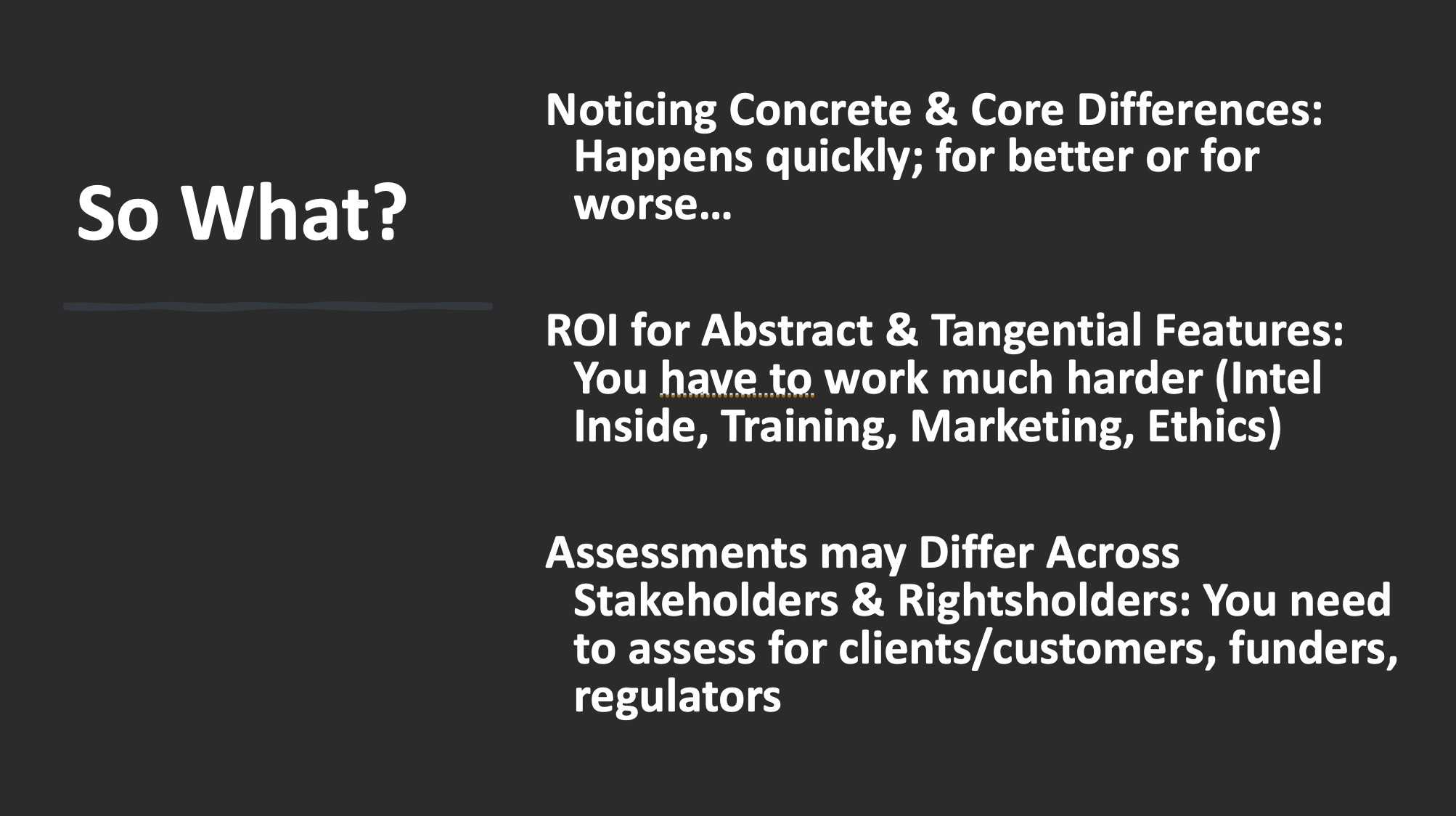
- Consider an elevator pitch for your innovation and place the main features on the core/tangential x concrete/abstract framework. Upload your draft feature map after watching the related videos below.
- Present live in our final sync session.
-
Likely "Run of Show" -- Presentation Lingo for What We'll Be Doing in Our Last Session (may shift given numbers enrolled)
- Live 5-minute presentations in breakout group - two "keepers" and two "improves" from colleagues
- Break to update presentations based on your received feedback
- Live 5-minute final presentations (either full cohort or in breakouts) - two "keepers" and two "improves" from colleagues
-
Material to Help You Share the Value of Your Innovation
Innovation Features -- Thinking About Your Audience
One of the hardest things for an innovator to do is to get into the head of a non-expert. Sometimes you have the great fortune of presenting to your peers, colleagues, or partners. You can use a common vocabulary. Other times, you present to people outside your field. These are likely experts in their own world but not in yours. For these people -- likely the majority of the people you will present to -- you have to keep in mind that what matters is how they understand you, not how much you tell them or what you know is true about your innovation (keep your Target in mind).
You can't move from invention to innovation if you can't get your ideas into effective use. Champion your innovation through clarity and an appreciation for your audience.
The next video is a bit dated, but his method still works.
Watch: Great way to get into the audience's head. (4m34s)
Watch: High-Level Presentation of Feature Mapping (5m02s)
Example of Making Abstract Features Less So
This is an old one from Intel. You can also think about all the marketing stickers on a non-Mac. A bit of the history.
Intel did a magical job of getting its brand into public awareness. How can you push your innovation there?
How about helping people be aware of the iPod (versus any other mp3 player out at the time). What feature of their innovation (besides iTunes which was the big strategic win) helped them stand out?
Advertising can educate (see this FaceTime ad) -- but could you make your innovation's value more understandable in other ways?
Are there features of your innovation that always raise the most questions or get the most searches on your Q&A website (you have one, don't you?) How could you adjust the design to make it easier for people to follow your intention? This site does a decent job summarizing Rogers' Diffusion of Innovation ideas (a classic book). Briefly (thanks to ChatGPT using this prompt: "Your audience are graduate students and faculty of science and engineering. They are entrepreneurs. Use Rogers' Diffusion of Innovation relative advantage, trialability, observability, compatibility, and complexity to suggest adjustments to a water desalination invention"):
- Relative Advantage: To maximize the relative advantage of your water desalination invention, you should focus on highlighting its benefits over existing solutions. Emphasize its cost-effectiveness, energy efficiency, and environmental friendliness compared to traditional desalination processes. You can achieve this by improving the technology's efficiency, reducing production costs, or enhancing the overall performance.
- Trialability: To increase the trialability of your invention, provide opportunities for potential adopters to test the technology before committing to full implementation. Offer pilot programs, on-site demonstrations, or sample units that allow users to evaluate the desalination system's effectiveness and benefits. By making your product more accessible and easier to test, you increase the likelihood that others will adopt the innovation.
- Observability: Ensure that the results and positive impacts of your water desalination invention are easily observable to potential adopters. Present case studies, testimonials, and data illustrating the technology's effectiveness in providing clean water, reducing energy consumption, and minimizing environmental impact. Collaborate with early adopters to showcase their successful implementation, so others can see the tangible benefits and be more likely to adopt your innovation. (Regarding the iPod question above -- think white. Observability can have negative broader effects. Sadly, still an issue: modern version. At the time, most mp3 players had black earbuds and cables.)
- Compatibility: Enhance the compatibility of your desalination invention by ensuring it aligns with your target audience's values, needs, and existing practices. Develop a modular design that integrates easily into existing water treatment infrastructure. Additionally, consider offering customizable features or versions tailored to specific industries, locations, or user requirements. By ensuring compatibility, you reduce the barriers to adoption and make it more appealing to potential users.
- Complexity: Finally, to address the complexity factor, strive to make your water desalination invention user-friendly and easy to understand. Simplify the installation, operation, and maintenance processes by providing clear instructions, training materials, and ongoing support. Develop a user interface that is intuitive and straightforward, allowing users to manage and monitor the system with minimal technical expertise. By reducing complexity, you increase the likelihood of adoption and user satisfaction.
Put It All Together in Your Presentation
It's time to revise your presentation from last term. Consider the feedback you received. Revise your presentation deck as needed. Think about whether the constantly evolving AI tools might offer new ways to share the value of your innovation. I recently created an animation using runwayml. It is free (I'll be paying for it after this trial period, given the number of presentations I do), less than five minutes, and just a touch more engaging than a static slide.
Next, transition to thinking about the physicality of your presentation. This is the approach you will use when you pitch in our final session, in your upcoming courses, and every time you share about your innovation.
My favorite presentation training source is Decker Communications. I've attended two of their multiday workshops and subscribe to their YouTube and blog content. It's hugely helpful. Duarte Communications is another great resource. I've included several links to their material below. As you watch these videos, pay special attention to the presenters' hands—and that they are standing! Find a way to stand or do whatever it takes for you to give your most powerful presentation. These pitches aren't meetings. They are you championing your innovation.
Watch: The Communicator's Roadmap (3m16s)
Watch: Specifics Setup Tricks for Online Presentation (1m39s)
Guessing you know these, but just in case:
Watch: Making the Connection (1m49s)
All of us are learning all the time about how to communicate complex information. You'll take the feedback here and present it again in your future i2I sessions. Public presentations are also on the table. Remember that I suggested 100 practice runs? Whether you're just starting, halfway there, or think 100 isn't enough, these are opportunities to get feedback from a friendly and interested community. Let me know in the discussion if you have any questions as you do your practice runs.
Additional Resources - Read/Watch as you have time.
- New Ventures BC Pitch Master Class: https://www.youtube.com/watch?v=xa_ujXVIYvM
- The Podium: To Use or Not to Use: https://www.linkedin.com/pulse/podium-use-bri-mcwhorter/
- Browse the Decker.com Leadership & Communication blog site: https://decker.com/blog/category/leadership-and-communications/
- I return to the Decker blog as I prepare for my pitches or keynotes. Think about how these ideas can help your innovation and other aspects of your work and life—we all "present" daily. Listen for comments about presentations that "stick" and presentations as a "contact sport."
- If you are presenting by sharing your PowerPoint screen, you may not want the presentation to take over the screen when you share your slides. Here is a technique for keeping the presentation in its own window. This enables you to see the audience and the chat window. Or not, as you choose. You can still control what you see on Zoom/Teams/etc. as normal.
- Browse the Decker.com Leadership & Communication blog site: https://decker.com/blog/category/leadership-and-communications/ The Decker blog is one I return to as I prepare for my own pitches or keynotes. Think about how these ideas can help your venture and other aspects of your work and life -- we all "present" every day. Look for their comments around presentations that "stick" and presentation as a "contact sport."
- If you are presenting by sharing your powerpoint screen, you may not want the presentation to take over the screen when you share your slides. Here is a technique for keeping the presentation in its own windowLinks to an external site.. This enables you to see the audience and the chat window. Or not, as you choose. You can still control what you see on zoom as normal.
- PowerPoint Cameo (embedding your live image in your slide)
- FameLab 2022 (3 minutes each). Skip to individual pitches.
- Mark Rober, ex-NASA engineer, current science educator, and YouTube guru, does an amazing job at making complex scientific and engineering concepts accessible to all (Think about your non-science or engineering-based funders, clients, etc.) This is a fun video in general, but at about 12 minutes his collaborators at the Salk Institute and he talk about using DNA to construct objects, very small ones, Think about how this might help you in presenting your own complex issues. https://youtu.be/9c2NqlUWZfo?si=LX8I-FNkTKn-WmA6
- From Microsoft Research: 1:01:12
Additional links related to pitch decks. I looked for early-stage examples. You can also check in with your mentors -- they have likely worked with the people who will ultimately see your i2I work.
-
- https://www.ycombinator.com/library/2u-how-to-build-your-seed-round-pitch-deck (Links to an external site.)
- https://www.universitylabpartners.org/blog/how-to-create-an-effective-biotech-pitch-deck (Links to an external site.)
- https://www.businessinsider.com/healthcare-biotech-pitch-decks-that-raised-millions-from-vc-investors (Links to an external site.)
- Duarte Resources. I think of Decker as the best West Coast communication consultant for the physicality of presentation. I think of Duarte as the best for slides/images/story. I also acknowledge that there may be great resources in BC and across Canada -- I just haven't had the chance to work with them yet. Feel free to give your recommendations in the discussion or as your resource contribution.
- https://sifted.eu/articles/seedcamp-78m-fund-pitchdeck/ (Links to an external site.)
- https://decker.com/blog/view-from-the-40th-floor-the-technology-multiplier/